
IAS with Dr Ravi · APPSC Daily Current Affairs
El Niño and Andhra Pradesh Agriculture: Kharif Risks Explained
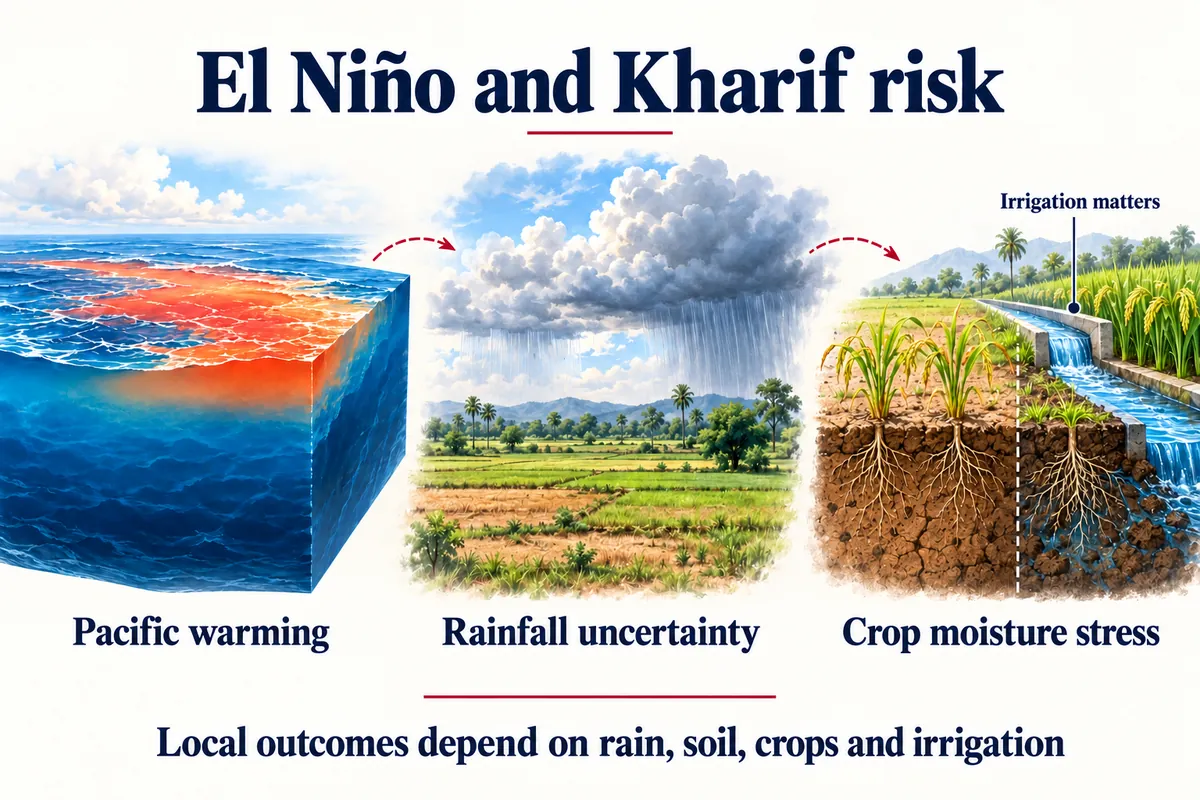
El Niño can increase the risk of a weaker Indian summer monsoon. For Andhra Pradesh’s farmers, the eventual damage also depends on when rain falls, crop growth stages and access to irrigation.
Why this matters in October 2026
The 8 October APPSC free preview discusses Kharif crop stress, repeated sowing and irrigation delays in Andhra Pradesh, drawing on an Eenadu report. It provides a useful starting point for connecting current affairs with agriculture and farmers’ welfare.
There is also an independently verified climate backdrop. IMD’s September 2026 ENSO bulletin reported strong El Niño conditions. The SASCOF-35 outlook, finalized on 1 October, described very strong conditions. These assessments establish the climate context; they do not measure crop losses in an individual district.
What is El Niño?
El Niño is the warm phase of the El Niño–Southern Oscillation, or ENSO. It involves unusually warm surface waters in the central and eastern equatorial Pacific together with changes in the atmosphere. La Niña is the cool phase; ENSO-neutral is the intervening state. During El Niño, the Pacific’s easterly trade winds generally weaken. WMO’s ENSO explainer sets out these features.
For prelims, locate the phenomenon in the equatorial Pacific. The Indian Ocean Dipole is a separate climate influence associated with the Indian Ocean.
Does El Niño always cause a poor monsoon?
The Ministry of Earth Sciences explains that El Niño is generally associated with a weaker Indian summer monsoon, but the relationship is not one-to-one. Other oceanic and atmospheric conditions influence rainfall, including the Indian Ocean Dipole and shorter-term weather variability. See the Ministry’s parliamentary answer of 15 March 2023, page 2.
A seasonal outlook describes probabilities over a period and region. It cannot, by itself, tell us whether a particular village will receive useful rain next week. The October–December SASCOF outlook also stresses regional factors and day-to-day weather variability. Keep the southwest monsoon and northeast monsoon seasons distinct when writing an answer.
Three pathways to crop stress in Andhra Pradesh
The agricultural issues in the free study preview, pages 2–4, can be organised into three pathways:
- Rain-fed crops: poor moisture at sowing can affect germination and seedling survival. Resowing adds seed, labour and other costs before the farmer earns any return.
- Irrigation-dependent cultivation: timely water matters alongside rainfall. Delayed releases or unreliable access can disrupt paddy transplanting even where irrigation infrastructure exists.
- Household livelihoods: crop stress can reduce expected income while input costs remain. Fodder shortages can also affect livestock, widening the pressure on a farming household.
These are pathways for analysis. Establish the extent of each problem using local observations rather than assigning every loss to El Niño.
Read agricultural data carefully
Rainfall deficit, sowing deficit and yield loss measure different things. Rainfall compares precipitation with a stated normal; sowing data measure the area planted; yield measures output per unit area. Production depends on both harvested area and yield.
Before quoting a percentage, identify its district or region, time period, baseline and source. A statewide total can conceal local stress. An early-season rainfall deficit should not be presented as the final seasonal result.
What should a balanced response include?
For a mains answer, connect immediate support with longer-term resilience:
- Timely information: use local forecasts and crop-specific advisories to guide farm operations. IMD provides district and block agromet advisory services.
- Water management: discuss timely irrigation, soil-moisture conservation and locally suitable water-saving practices.
- Contingency planning: assess crop choices and sowing windows with agricultural experts, taking account of soil, water availability and market access.
- Targeted support: assess actual crop damage and household needs. Relief and insurance must be discussed with their applicable eligibility conditions, rather than assumed to follow automatically from an El Niño announcement.
These are analytical recommendations, not a claim that every measure has been implemented in Andhra Pradesh.
An APPSC mains answer framework
Practice prompt: Explain how climate variability can affect Kharif agriculture in Andhra Pradesh. Suggest measures to reduce farmers’ vulnerability.
Begin with ENSO and its conditional relationship with the monsoon. Explain the effects of dry spells on sowing, crops, irrigation demand and incomes. Add the importance of district-level evidence. Conclude with weather advisories, water management, locally suitable crop planning and targeted support.
A useful closing point: agricultural resilience depends on converting climate information into timely, local action.
Three quick revision questions
1. In which ocean does El Niño develop?
The equatorial Pacific, with unusually warm surface waters in its central and eastern parts.
2. Does an El Niño announcement prove district-level crop damage?
No. Crop damage needs local evidence on rainfall, soil moisture, crop condition and irrigation access.
3. Can sowing area alone establish total production?
No. The area ultimately harvested and the yield per unit area both matter.